
Basement Mold Removal
Finished and unfinished basements wet from snowmelt and groundwater.
Learn more →Burst pipes in January, snowmelt in April, river floods in June. We dry the structure, remove what stayed wet too long and document everything for your insurer.
Get a Free QuoteA pipe freezes and splits during a January cold snap, and a bathroom ceiling comes down. A water heater lets go in the basement over a long weekend. A river comes up in June. The water itself is the first problem; the mold that follows inside wet walls, under flooring and behind cabinets is the second, and it starts within a day or two.
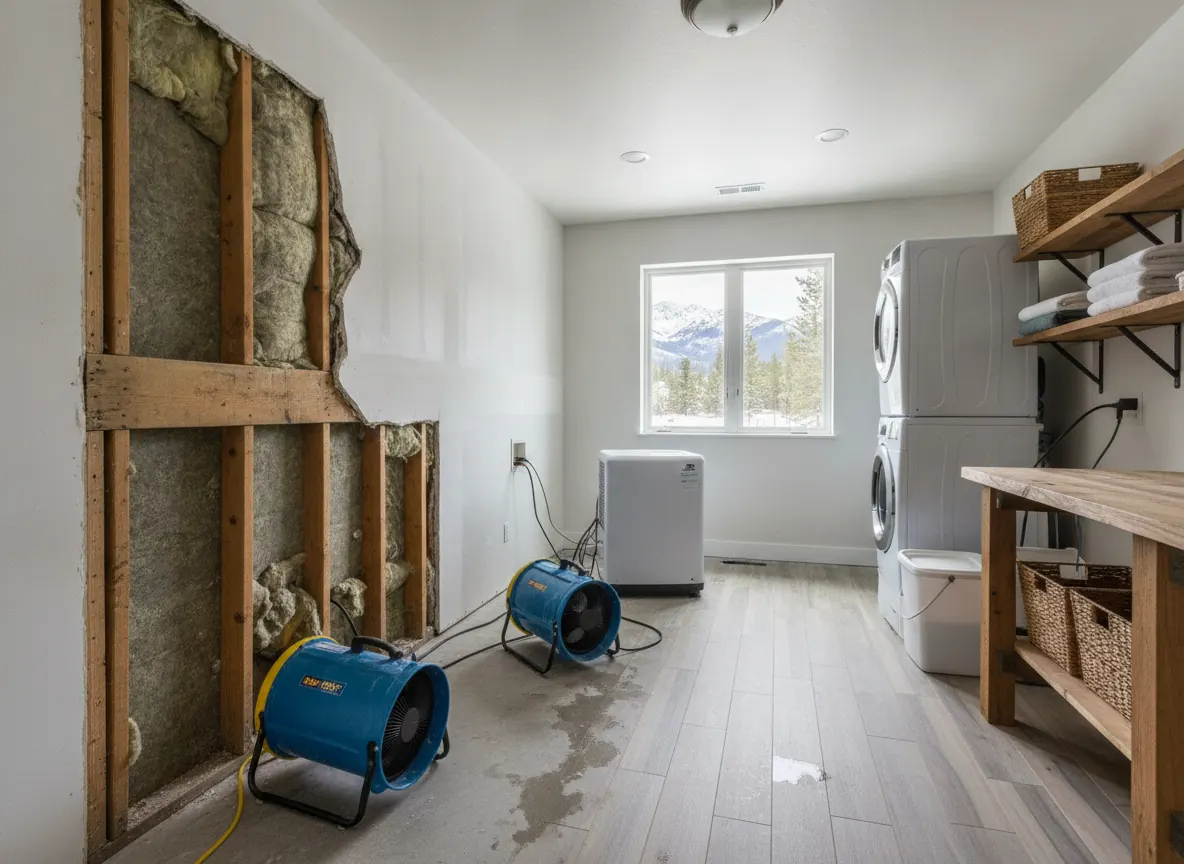
The mistake most people make is stopping once the surface looks dry. Drywall, carpet pad and framing hold water long after the floor feels fine, and a fan pointed at a wall does not dry what is inside it. Water damage cleanup done right is a drying job measured with meters, followed by mold remediation wherever the materials stayed wet too long.
Cold does the damage here. With January lows averaging 12°F in Bozeman and 0°F in West Yellowstone, pipes in exterior walls, crawl spaces, garages and unheated second homes freeze and burst every winter. Big Sky, where 57 percent of housing units sit vacant as second homes, sees burst pipes discovered weeks after the fact, which is long past the 24 to 48 hour window.
Then there is flooding. Spring snowmelt brought valley-wide flood warnings in April 2018, and the Gallatin River hit roughly 8,930 cfs in June 2022. The same June, the Yellowstone River flood damaged 205 residences in Park County, destroyed three and partially damaged 76, with southeast Livingston and the Ninth Street Island area hit hardest under FEMA disaster declaration DR-4655. In Three Forks, about 80 percent of structures sit in the regulatory floodplain. Floodwater soaks everything below the waterline, carries silt and contaminants, and leaves walls wet for far longer than two days unless they are opened up and dried on purpose.
Dry it on purpose, remove what stayed wet, document everything.
Once the water source is off, we extract standing water, pull wet carpet and pad, and set air movers and dehumidifiers. The sooner this starts, the less mold remediation you will need. Same-day reply, free estimate.
Moisture meters and thermal imaging map how far the water traveled inside walls, under floors and into adjacent rooms. Photos, readings and a written scope go to you and, if you want, your insurance adjuster.
Porous materials wet more than two days are bagged and removed under containment with HEPA air filtration. Framing and hard surfaces are cleaned, treated and dried to target readings. Our technicians follow IICRC S520 guidelines for the mold portion.
We log moisture readings until materials are at target, offer optional third-party clearance testing, and hand off a clean, dry structure to your rebuild contractor along with the documentation your insurer needs.
| Job | Typical range |
|---|---|
| Water-damage + mold (burst pipe/flood room) | $2,000 – $6,000 |
| Basement (one area) | $1,000 – $4,000 |
| Whole-home / major | $10,000 – $30,000+ |
| Post-remediation clearance test | $200 – $400 |
Contents removal adds roughly $300 to $1,000 depending on volume. Rebuild and drywall are quoted separately. See the full price table and calculator on our mold remediation cost guide, or request a free quote for a written scope on your home.
Adjusters want to see cause, timeline and evidence. Photograph the source and the damage before anything is moved, note the date and time you discovered it, and keep every receipt. Ask us for the written scope, the moisture log, the disposal inventory and before-and-after photos; we produce those on every water loss because they answer the questions an adjuster will ask.
Sudden events like burst pipes are treated differently from slow leaks and seasonal seepage, and mold coverage often has its own limit. We cannot interpret your policy for you, but we can make sure the paperwork is complete. For flood losses, FEMA assistance and flood insurance follow their own rules; keep your claim numbers with your documentation.
Mold can begin growing on wet drywall, carpet pad and wood within 24 to 48 hours. That is why the first two days matter more than anything else. Get the water stopped, get standing water out, and get air moving and dehumidifying immediately. Anything still wet after about two days is likely to be a mold problem rather than a drying problem.
MSU Extension’s guidance is to discard porous items that stayed wet for more than two days: carpet and pad, upholstered furniture, mattresses, paper-faced drywall, fiberglass insulation and particleboard. Hard, non-porous materials like framing, concrete, metal and solid wood can usually be cleaned and dried. We photograph and inventory everything removed so your insurer sees the reason for each item.
Often the sudden water event, like a frozen pipe that bursts, is covered, and mold that results from it may be covered up to a limit, while mold from long-term leaks or neglected maintenance usually is not. Policies vary a lot. Call your carrier early, document everything with photos and dates, and ask us for the written scope, moisture logs and disposal inventory they will want.
Most burst-pipe or flooded-room jobs in the Bozeman area fall between $2,000 and $6,000 for the mold remediation portion. Larger losses, like a finished basement under a foot of water, can move into the whole-home range of $10,000 to $30,000 or more. Rebuild is separate. The cost guide explains how the square-foot math works.
Yes. We serve Livingston and the surrounding Park County area, which saw 205 residences damaged in the June 2022 Yellowstone River flood, with southeast Livingston hit hardest. Flood-soaked homes that were not fully dried in time still show mold years later behind finished walls. If your home was affected and still smells musty, an inspection with moisture readings is the place to start.
Finished and unfinished basements wet from snowmelt and groundwater.
Learn more →What dark mold on soaked drywall means and how we remove it.
Learn more →Typical Bozeman-area price ranges, a square-foot calculator and the factors that move a quote up or down.
Learn more →This service is available across Bozeman & the Gallatin Valley, MT, including:
See all service areas or learn how our process works.
Tell us what you're seeing. We reply fast, usually the same day, with a clear plan and typical pricing.