
Basement Mold Removal
Snowmelt, high water tables and sealed basements in the Gallatin Valley.
Learn more →Vented crawl spaces, bare soil and Montana winters put mold right under your floor. We remove it, dry the framing and give you a moisture plan that lasts.
Get a Free QuoteNobody goes in the crawl space on purpose. That is why crawl space mold in Gallatin Valley homes usually gets found by a plumber, a home inspector during a sale, or a homeowner chasing a musty smell that will not leave the living room. By then the joists and subfloor may show white, green or black growth, the fiberglass batts are sagging and wet, and the vapor barrier, if there is one, is torn and buried.
The trouble is that your crawl space is not separate from your house. Air moves up through it constantly. Fixing crawl space mold is as much about the floor you walk on as the dirt underneath it.
Most local crawl spaces were built vented, with the idea that outdoor air would keep them dry. In Bozeman’s winter that logic breaks. With January lows averaging 12°F and the snowpack sitting on the vents for months, the crawl is a cold box under a warm house. Warm, humid indoor air leaks through the floor, hits the cold framing and condenses. Modeled relative humidity in January is around 95 percent, so there is plenty of moisture to work with.
Bare dirt adds more. Soil gives off water vapor year-round, and spring snowmelt raises groundwater so standing water is common in low crawl spaces around Belgrade, Manhattan and Three Forks. Rural homes in Bridger Canyon, Gallatin Gateway and the Churchill farm country often sit on older foundations with no vapor barrier at all. Then the stack effect pulls that damp air up through every gap in the floor, which is why the house smells like the crawl.
Full-footprint inspection, containment and a moisture plan in writing.
We crawl the entire footprint, meter the joists and subfloor, check for standing water, failed vapor barrier, plumbing leaks and dryer or bath vents dumping into the crawl. The written scope maps exactly what we found.
We seal the crawl access and any floor registers, run HEPA air filtration under negative pressure, and protect the path from the access to the door so nothing tracks through your home.
Wet or moldy insulation and debris come out in sealed bags. Joists, subfloor and sill plates are HEPA-vacuumed and cleaned with detergent and antimicrobial. We set drying equipment and monitor moisture readings until framing hits target.
Every scope includes a moisture plan: grade and drainage, a sealed vapor barrier over the soil, insulation corrections and venting. If encapsulation or a conditioned crawl space makes sense, we refer you to a contractor who does that work.
| Job | Typical range |
|---|---|
| Crawl space | $1,000 – $3,500 |
| Small contained area (localized growth) | $500 – $1,500 |
| Post-remediation clearance test | $200 – $400 |
Access height, square footage and how much insulation has to come out are the biggest cost drivers. See the full price table and calculator on our mold remediation cost guide, or request a free quote for a written scope on your home.
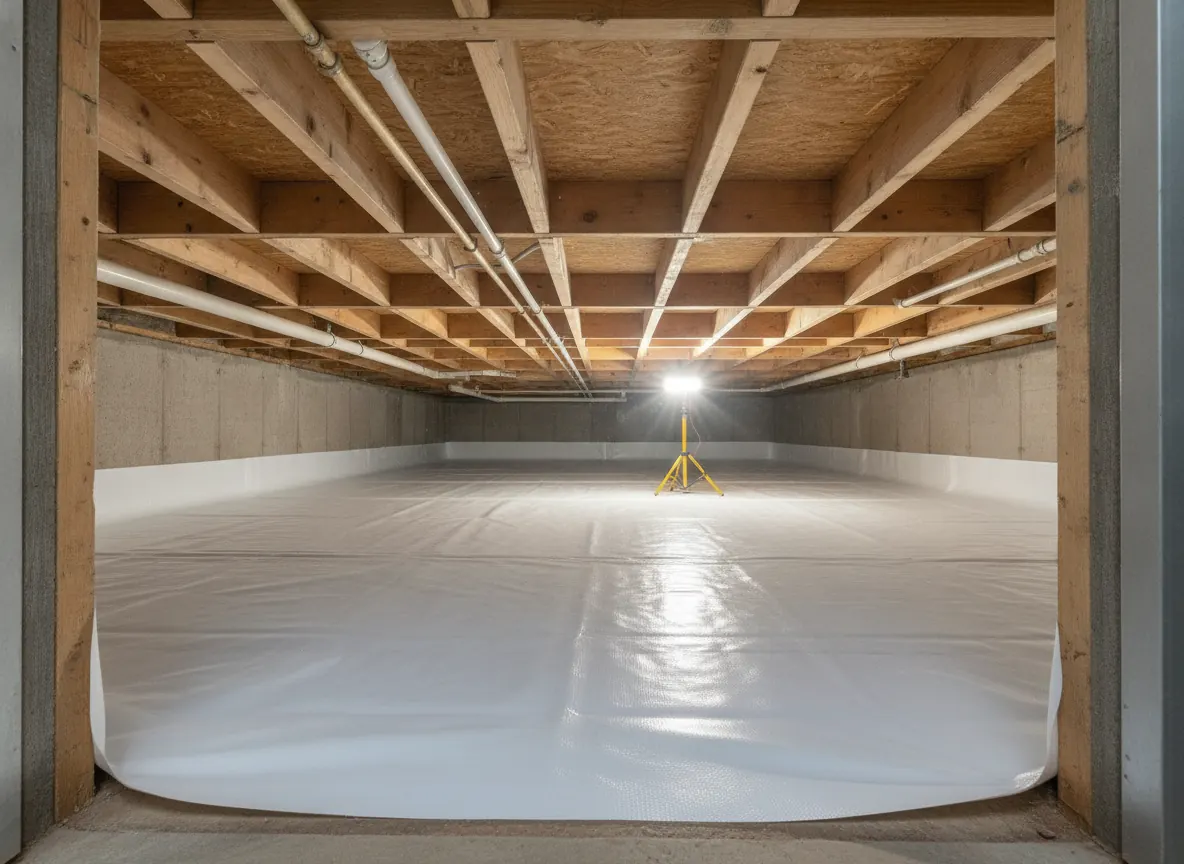
A lot of the homes we see outside Bozeman city limits were built on crawl spaces decades ago, before vapor barriers were standard. Farmhouses around Churchill and Amsterdam, cabins up Bridger Canyon, and older places along the Gallatin River near Manhattan often have dirt floors, open vents and plumbing that has leaked more than once. We treat those differently than a 2015 subdivision crawl with a concrete rat slab.
The remediation is the same, but the moisture plan is where the real work is. We put it in writing so you can hand it to a foundation, insulation or encapsulation contractor and know the mold will not simply return next winter.
Yes, and winter is when it happens. Summers in Bozeman are dry with essentially zero muggy days, but a crawl space in January is a different place. Warm house air leaks down through the floor, meets ground and vents near 12°F, and condenses on joists and subfloor. Add bare soil giving off moisture all year and spring snowmelt seeping in, and you get mold on the underside of your floor.
Closing vents alone is not a fix and can trap moisture if there is no vapor barrier. The better sequence is: dry out the space, cover the soil with a sealed vapor barrier, insulate the perimeter walls or floor correctly, and then decide whether to condition the space. Many Gallatin Valley homes end up with an encapsulated crawl space, which we can refer you to a contractor for after remediation.
Most crawl space jobs in the Bozeman area fall between $1,000 and $3,500. Crawl spaces cost a little more per square foot than basements because of access and working conditions. If the subfloor or joists need structural repair, or if you add encapsulation afterwards, those are separate costs. Our cost guide shows how the ranges are built.
It can. In a typical home, a good share of the air you breathe on the first floor came up through the crawl space, carried by the stack effect as warm air rises and escapes through the attic. That is why a musty smell in the living room often traces to the crawl. Mold can affect people with asthma or allergies; if anyone has symptoms, see a doctor and get the crawl space looked at.
If the fiberglass batts under the floor are wet, sagging or moldy, they come out and are bagged for disposal. Wet fiberglass does not dry well in a crawl space and holds moisture against the subfloor. After cleaning and drying, we recommend the right insulation approach for the space, which is often rigid foam on the perimeter walls rather than batts between the joists.
Snowmelt, high water tables and sealed basements in the Gallatin Valley.
Learn more →Moisture mapping, thermal imaging and sampling when you cannot see the source.
Learn more →Typical Bozeman-area price ranges, a square-foot calculator and the factors that move a quote up or down.
Learn more →This service is available across Bozeman & the Gallatin Valley, MT, including:
See all service areas or learn how our process works.
Tell us what you're seeing. We reply fast, usually the same day, with a clear plan and typical pricing.