
Rental Property Mold
Montana disclosure rules, documentation and the landlord-tenant side of mold.
Learn more →Restaurants, rental buildings, offices and short-term rentals across the Gallatin Valley. Contained work on your schedule, with the documentation insurers and tenants ask for.
Get a Free QuoteIn a home, mold is an inconvenience. In a restaurant, a dental office, a rental building or a short-term rental in Big Sky, it is a closed door, a complaining tenant, a guest refund or a lease dispute. Commercial mold remediation has to solve the mold and protect the operation at the same time: minimal downtime, clean containment, clear documentation and a fix for the moisture problem so it does not repeat next winter.
We work with owners, property managers and facilities staff on small and mid-size commercial buildings across the Gallatin Valley. Every job starts with a written scope, and we schedule around your hours rather than ours.
The same winter that drives residential mold works harder on commercial buildings. Restaurants push steam and dishwashing moisture into tight kitchens all day. Offices and retail spaces with rooftop units and ductwork spread condensation and cold spots across the building; HVAC mold is one of the more expensive problems to fix. Flat and low-slope roofs hold 86 to 91 inches of annual snow, and ice dams at parapets and scuppers put water into ceiling tiles and wall cavities.
Rental housing is its own category. About 35 percent of Bozeman housing is apartments and other multi-unit stock, serving a city of 58,814 and a Montana State University enrollment that hit a record 17,165 students in fall 2025. Bath fans that vent nowhere, windows that fog all winter and tenants who dry laundry indoors create condensation mold unit by unit. In November 2024, tenants at Bridger Heights in Bozeman organized a tenants union with mold and ventilation among their stated complaints, a reminder that unresolved moisture issues become landlord-tenant issues. In Big Sky, second-home condos and short-term rentals sit vacant for stretches at nearly 7,000 feet, where a frozen pipe or a cold-wall condensation problem can run for weeks before anyone opens the door.
Written scope, after-hours work, insurer-ready documentation.
We inspect the building, meter and image the affected areas, identify the moisture source, and write a scope that includes square footage, materials to be removed, containment layout, access plan and a work schedule built around your hours.
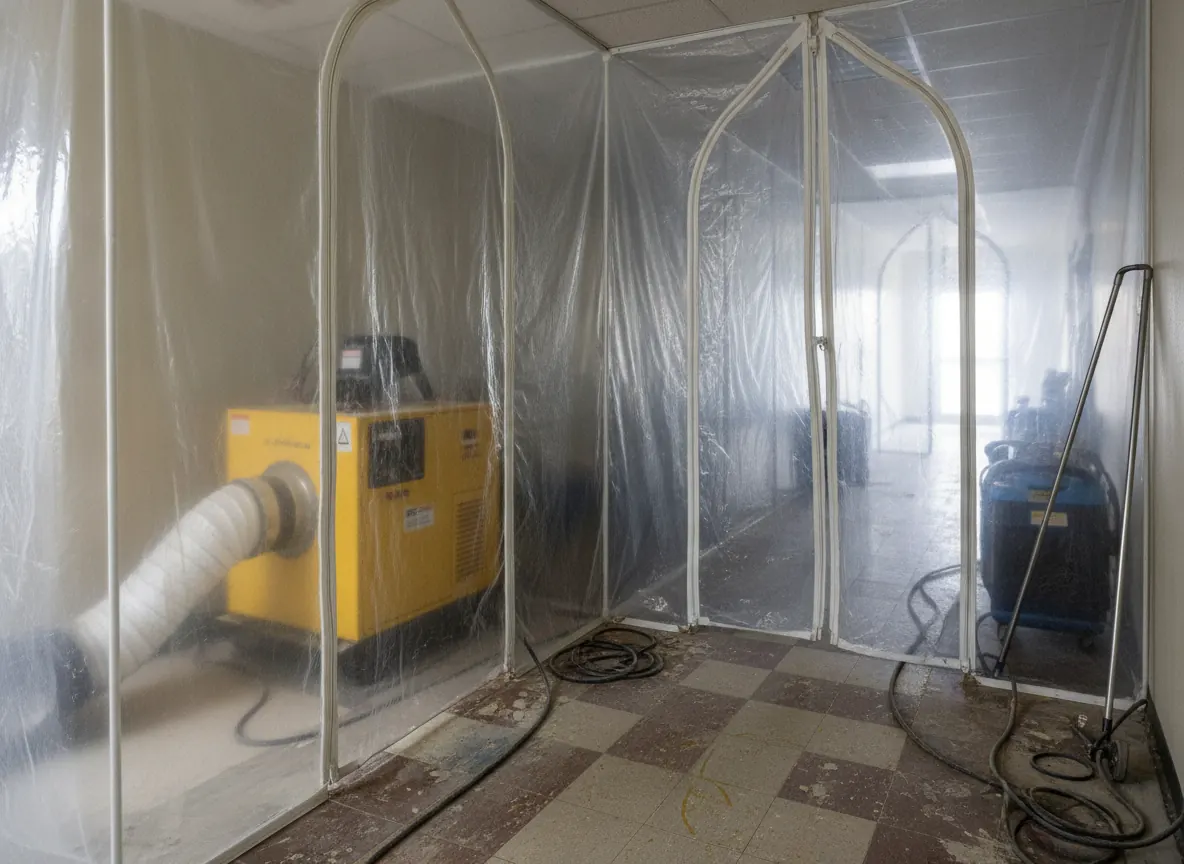
Plastic containment seals the work zone and HEPA air filtration runs under negative pressure. HVAC supplies and returns in the zone are sealed so spores do not travel through the duct system to the rest of the building.
Affected drywall, ceiling tile, insulation and flooring are removed and bagged. Framing, masonry and hard surfaces are HEPA-vacuumed, cleaned and dried to target readings. Our technicians follow IICRC S520 guidelines. HVAC and duct work is coordinated with your mechanical contractor.
You receive a completion report with photos, moisture logs, disposal inventory and optional third-party clearance results, formatted for insurers, tenants, buyers and your own records. The moisture-fix recommendation comes with every job.
| Job | Typical range |
|---|---|
| Small contained area (under 10 sq ft) | $500 – $1,500 |
| Basement / storage (one area) | $1,000 – $4,000 |
| HVAC / ductwork | $3,000 – $10,000 |
| Whole-building / major | $10,000 – $30,000+ |
Commercial jobs are priced per square foot ($10 to $25) with modifiers for location, HVAC involvement and after-hours scheduling. See the full price table and calculator on our mold remediation cost guide, or request a free quote for a written scope on your home.
Restaurants and cafes downtown and along Main Street, where kitchen humidity and old brick walls meet. Property managers handling student rentals near MSU and apartment complexes in the northwest subdivisions. Office and medical suites with rooftop HVAC. Short-term rental owners and HOA boards in Big Sky and West Yellowstone, where lodging sits empty between bookings. Small warehouses and shops in Belgrade and Four Corners with slab-on-grade moisture.
Each gets the same thing: a straight assessment, a scope you can hand to your insurer or your tenants, and a plan for the moisture so you are not calling us back next February.
Yes. For restaurants, offices, retail and lodging we schedule evening, overnight and weekend work whenever containment allows it. The affected area is sealed off with plastic and HEPA air filtration runs under negative pressure, so adjacent spaces can often stay open during business hours. We put the schedule, access plan and noise expectations in the written scope before we start.
A written scope before work, photos before and after, moisture readings and drying logs, a disposal inventory for removed materials, and optional third-party clearance test results. For landlords, that file also supports your obligations under Montana’s Mold Disclosure Act (MCA 70-16-703), which requires disclosure of known mold and any testing or mitigation to future tenants or buyers.
It depends on square footage and what the mold is growing on. Per-square-foot pricing of $10 to $25 is the starting point; a single contained area may run $500 to $1,500, a basement or storage area $1,000 to $4,000, and HVAC or ductwork involvement $3,000 to $10,000. Larger buildings can reach $10,000 to $30,000 or more. Our cost guide has the full table.
We do. Big Sky has 3,504 housing units with about 57 percent vacant as second homes, and a rental vacancy rate near 28.7 percent, so a lot of condos sit empty for weeks at elevation 6,936 feet. Burst pipes and condensation problems get discovered by guests or cleaners. We coordinate with property managers for access and schedule around bookings whenever possible.
Yes. Kitchens and walk-in coolers combine steam, condensation and frequent washing, and mold shows up on ceiling tiles, behind equipment, around cooler gaskets and in floor drains. We contain the area, remove affected materials, clean and dry, and recommend ventilation or condensation fixes. Overnight scheduling keeps you open. Contact your health department for any reopening or inspection requirements specific to your operation.
Montana disclosure rules, documentation and the landlord-tenant side of mold.
Learn more →Burst pipes and flood losses, dried and documented for insurance.
Learn more →Typical Bozeman-area price ranges, a square-foot calculator and the factors that move a quote up or down.
Learn more →This service is available across Bozeman & the Gallatin Valley, MT, including:
See all service areas or learn how our process works.
Tell us what you're seeing. We reply fast, usually the same day, with a clear plan and typical pricing.