
Our Mold Remediation Process
Six steps, in the order we actually do them, so you know what is happening in your home and why. The scope is in writing before step three begins.
Get a Free Quote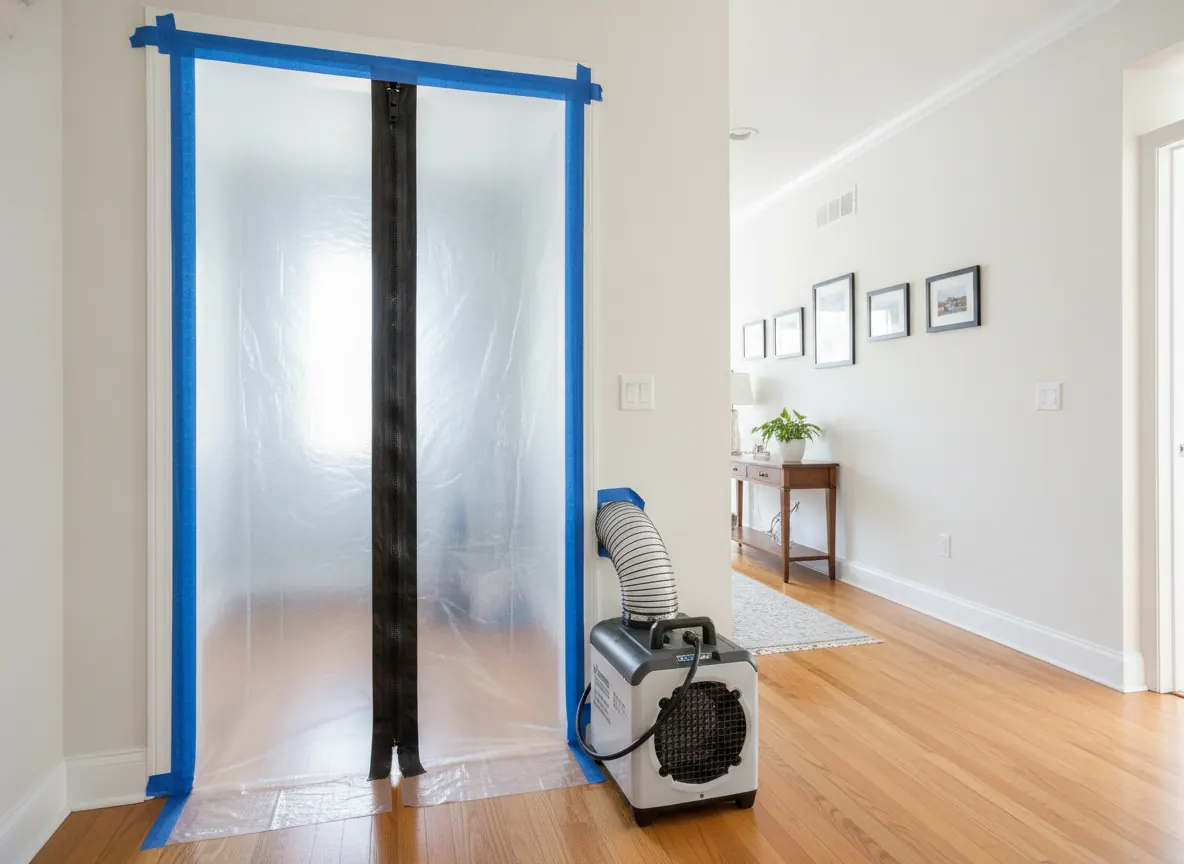
Why the order matters
Mold is a moisture problem with a biology symptom. Companies that skip straight to removal, or that spray a product and leave, get repeat calls. Our sequence puts inspection and the written scope ahead of any demolition, puts containment ahead of any cutting, and puts the moisture fix ahead of any rebuild. It is slower on paper and faster in practice, because nothing has to be redone.
Montana has no state license for mold remediation, so there is no rulebook a company is required to follow. We use the IICRC S520 standard as our guideline for containment, removal and cleaning, and we put the method in writing so you can hold us to it.
The six steps
Inspection and moisture mapping
We start by looking, not cutting. A technician inspects the visible growth, checks adjacent rooms and uses a pin meter and thermal imaging to map how far the moisture extends inside walls, floors and ceilings. We trace the water to its source, whether that is a plumbing leak, an ice dam, a condensation point or groundwater. Air or surface sampling is offered only if it will change a decision, such as hidden growth, a sensitive occupant or documentation for a sale or lease.
Written scope and quote
Before anything is touched you receive a plain-language scope. It lists the areas to be contained, the materials to be removed, the surfaces to be cleaned, the equipment we will run, the estimated schedule and the price. It also states our recommendation for fixing the moisture source. You can take it to your insurer or compare it with another company line by line.
Containment and negative air
The work area is sealed with plastic sheeting and zippered entries. Negative air machines with HEPA filtration pull air from inside the containment, filter it and exhaust it outside, so the rest of the home stays at normal pressure and spores do not travel. HVAC registers in the zone are sealed. For larger jobs we add a decontamination chamber where technicians change out of protective gear.
Removal and HEPA cleaning
Porous materials that cannot be cleaned, such as wet drywall, insulation, carpet pad and particleboard, are cut out, bagged inside the containment and carried out. Framing, subfloor and hard surfaces are HEPA vacuumed, cleaned with detergent, and HEPA vacuumed again. Technicians follow IICRC S520 guidelines for mold remediation. Nothing gets painted over or sprayed and left.
Drying and the moisture fix
Clean materials are dried to normal moisture content with air movers and dehumidifiers if needed, verified with the same meters used at inspection. This is also when the moisture source gets fixed, by us if it is simple, or by a plumber, roofer or ventilation contractor if it is not. We will not call a job done while the water is still coming in.
Optional clearance testing and rebuild
If you want independent proof, we arrange third-party clearance testing before the containment comes down. The tester compares air samples inside the work zone to outdoor and unaffected indoor samples. Once the area passes, or once you are satisfied by visual inspection, the plastic comes down and rebuild can begin, either with us or a contractor you choose. You receive photos and a close-out summary for your records.
What you can do before we arrive
- Stop the water if you can. Shut the supply valve, put a bucket under the drip, or clear the roof edge if an ice dam is actively leaking.
- Do not scrub, bleach or paint the growth. Disturbing it spreads spores, and bleach on drywall mostly adds water. MSU Extension recommends detergent first and a 1:10 bleach solution only on hard surfaces.
- Keep the area closed off. Shut the door, and if the HVAC return is in the room, switch the fan to off until we arrive.
- Move belongings you want to keep out of the affected room, especially porous items like books, fabric and cardboard. Anything that has been wet more than two days should be considered for disposal.
- Take photos with dates for your insurer, and note when you first saw the growth or the leak.
- Tell us about anyone in the home with asthma, allergies or other respiratory concerns so we can plan containment and scheduling around them. If anyone has symptoms, see a doctor.
What to expect during the job
Most homeowners stay in the house. The containment keeps dust and spores inside the work zone, and the negative air machines are the loudest part, something like a box fan. We will tell you which rooms to avoid, where our path in and out runs, and roughly how many days to plan for. Small bathroom or closet jobs often finish in a day. Basements and attics typically take two to four. Water-damage jobs add drying time on the front end.
You will get an update at the end of each day and a call before we remove containment. If we find more growth than the scope covered, which happens when drywall comes off, we stop, show you, and revise the scope in writing before continuing.
See typical pricing for each kind of job on our cost guide, or learn how we handle basements, attics and water-damage cleanup. Answers to common questions are on the FAQ.
Worried about mold? Get a straight answer and a free quote.
Tell us what you're seeing. We reply fast, usually the same day, with a clear plan and typical pricing.