
Water Damage & Mold Cleanup
Burst pipes, flooded rooms and the 24–48 hour window before mold takes hold.
Learn more →Snowmelt, a high water table and tightly sealed basements make mold common below grade in the Gallatin Valley. We remove it, dry it and tell you how to keep it from coming back.
Get a Free QuoteBasement mold in Bozeman rarely announces itself. It starts as a faint smell on the stairs, a soft spot in the drywall behind the furnace, or dark speckling on the back of a bookshelf pushed against an exterior wall. In finished basements it hides under carpet pad, behind paneling and inside the bottom foot of insulated walls, exactly where the concrete is coldest and dampest.
Left alone it does not stop; the moisture returns every spring. People with asthma or allergies may notice symptoms in the basement first; if anyone is reacting, talk to a doctor while you get the moisture under control.
The Gallatin Valley is a dry place with a wet foundation problem. Snowmelt is the big one. Valley-wide flood warnings went out during the April 2018 melt, and every spring the ground around foundations saturates faster than it can drain. Water enters at cracks, cold joints, window wells and the slab edge, then concrete wicks it through to the finished side.
The water table does the rest. West of town around Four Corners, the alluvial aquifer sits roughly 55 feet down and rises with runoff; the area grew 88 percent between 2010 and 2020 on ground that was unzoned in 2004, so a lot of basements went in without much thought to drainage. Closer to the rivers in Manhattan and Three Forks, the water sits even higher.
Then there is the radon factor. Gallatin County’s radon levels have pushed many homeowners to seal basements tight and run mitigation fans. That is the right call for radon, but a sealed basement with no humidity plan holds moisture, and in finished basements like those in Cattail Creek and Norton Ranch, mold grows where nobody looks.
IICRC S520-guided, with a moisture fix built into every scope.
We meter the walls, slab and framing, use thermal imaging to find the wet zones behind finishes, and trace where the water comes in. You get a written scope before any demolition.
Plastic containment seals the work area from the rest of the home. HEPA air scrubbers run under negative pressure so spores and dust stay put. Your HVAC returns in the basement get sealed off.
Porous materials that are moldy or were wet more than two days, such as drywall, carpet pad and fiberglass insulation, are bagged and removed. Framing and concrete are HEPA-vacuumed, cleaned with detergent and antimicrobial, and dried to target moisture levels with monitored equipment.
Every job comes with a written moisture-fix recommendation: sump, drainage, grading, sealing or dehumidification. Optional third-party clearance testing confirms the area is back to normal before you rebuild.
| Job | Typical range |
|---|---|
| Small contained area (under 10 sq ft) | $500 – $1,500 |
| Basement (one area) | $1,000 – $4,000 |
| Water-damage + mold (flooded basement room) | $2,000 – $6,000 |
| Post-remediation clearance test | $200 – $400 |
Finished basements cost more because more material comes out. See the full price table and calculator on our mold remediation cost guide, or request a free quote for a written scope on your home.
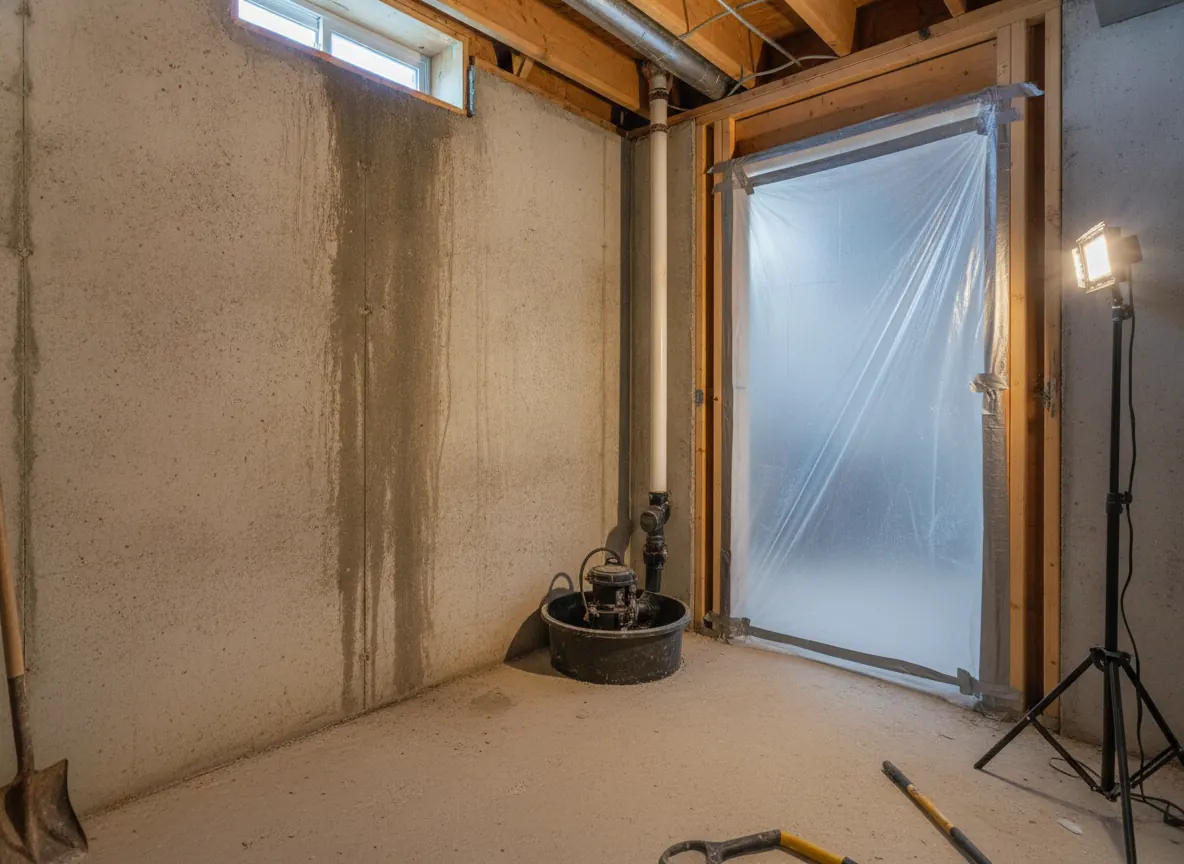
In an unfinished basement, mold on block or concrete is straightforward: clean, dry, control humidity. In a finished basement the mold is usually inside the wall assembly, so we open the bottom of the wall, remove what is affected, and leave the rest intact. We photograph everything so you and your insurer can see exactly what came out and why.
We also look at the things that keep a basement wet after the water stops: carpet directly on slab, vapor barriers on the wrong side of the insulation, dryers venting into the room, and sump pits without a lid. You get all of it in writing so the rebuild does not repeat the problem.
Spring snowmelt is the usual answer. Bozeman gets 86 to 91 inches of snow a year, and when it melts in March and April the ground around your foundation saturates. Water finds cracks, cold joints and window wells, and concrete wicks moisture through to the finished side. The smell is mold feeding on that seasonal dampness, often behind paneling or under carpet pad where you cannot see it.
In most cases, yes. We seal the work area with plastic containment and run HEPA air filtration under negative pressure, so dust and spores stay in the basement rather than drifting upstairs. You will lose use of the basement for the duration, and anyone with asthma or allergies may prefer to be out during demolition days. We talk this through in the written scope.
We identify it and put the fix in writing with every job, because remediation without a moisture fix is temporary. Some fixes we handle directly, like sealing penetrations or adding a dehumidifier plan. Larger drainage work, sump pump installation, grading or foundation waterproofing we refer to contractors who do that every day. We will not sign off until the source has a plan.
Most single-area basement jobs in the Bozeman area fall between $1,000 and $4,000. A small spot behind a utility sink sits lower; a finished basement with wet drywall, carpet and insulation across several rooms sits higher, and may move into the water-damage range of $2,000 to $6,000. Our cost guide explains the per-square-foot math.
No, but the two issues share a cause. A 2005 Gallatin County study found a mean radon level of 6.1 pCi/L, with 40 percent of homes over the 4 pCi/L action level, so many local basements are sealed and depressurized. A tight basement holds moisture that used to leak out. The answer is not to unseal it; it is to control humidity with ventilation and dehumidification.
Burst pipes, flooded rooms and the 24–48 hour window before mold takes hold.
Learn more →Vented crawl spaces, vapor barriers and the cold-winter moisture cycle under rural homes.
Learn more →Typical Bozeman-area price ranges, a square-foot calculator and the factors that move a quote up or down.
Learn more →This service is available across Bozeman & the Gallatin Valley, MT, including:
See all service areas or learn how our process works.
Tell us what you're seeing. We reply fast, usually the same day, with a clear plan and typical pricing.